The Orélien Effect on ITAD
When new technology makes something that was previously difficult to verify suddenly easy to challenge.
Until a few weeks ago, Thélyson Orélien was having the debut authors hope for. His first novel, C’était ça ou mourir (It Was Either That or Die), had won the Prix du roman Fnac, sold into translation, and sat on the lists for several of France’s major prizes, including the Goncourt.
Then someone ran the book through a detector.
On September 21, 2026, the day he won the Fnac prize, an anonymous account posted Pangram screenshots and said the excerpts scored as almost entirely machine written. Journalists ran their own checks. France Inter and CBC got the same kind of result from Pangram. Full book runs reported elsewhere landed in the low to mid 90s. Other detectors disagreed. Orélien denied using generative AI and said the manuscript was finished in 2019. His publishers initially stood by him.
Within days the Académie Goncourt removed the novel. It cited those AI findings and earlier plagiarism allegations. It did not wait for a court.
Whether he wrote every word is not the lesson. What happened to the claim is.
Who actually wrote these pages had been difficult to test. It became cheap to challenge in public, while the work was still in the prize window. The effect does not wait for proof. It shifts the burden. Once a claim can be tested, the person who made it is expected to back it up. Orélien learned about the accusation the same way everyone else did: in public, with a number attached, defending himself on someone else’s terms.
That is the Orélien Effect.
IT asset disposition is about to have its version of that day.
The difficulty was the moat
For years, the controlling document in ITAD has been a representation. A certificate of destruction. A quarterly total. A vendor’s assurance that what left the building was received, sanitized, and dispositioned.
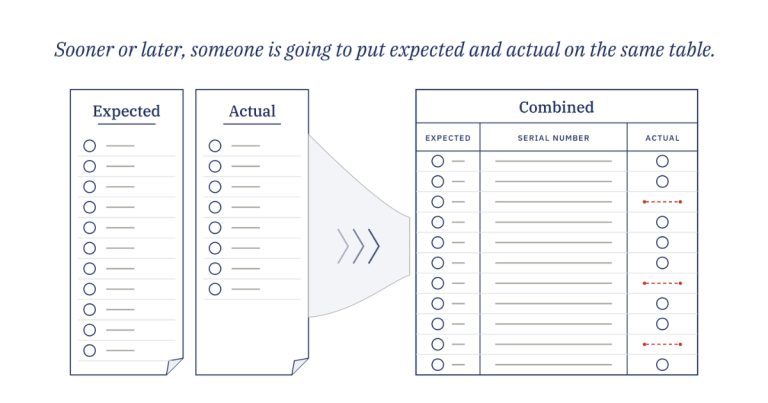
The client has one record of what it believes left. The processor has another record of what it says arrived. Those records should match. Historically, proving that they matched was cumbersome. Different systems, different clocks, serials entered differently, assets nested inside other assets, partial pickups, manifests that change. Someone has to normalize the lists, find the likely matches, and decide which exceptions have a reason.
So most programs never did it. The certificate stood in for the population.
Those documents are not useless. They are not reconciliation.
The difficulty was the moat. Not around fraud in particular. Around not knowing.
What “suddenly easy” changes
The danger is not that a model will discover something nobody knew. It is that comparing the two lists is no longer an expensive project.
An enterprise can hand over years of retirement records and years of receiving reports and ask a plain question: compare what we say we retired with what our providers say they received, and show everything that does not match.
An internal auditor can ask that. A CISO can. An insurer after an incident. A regulator. An acquirer in diligence. Outside counsel. A former employee with two spreadsheets.
The processor does not decide whether the reconciliation happens. Neither does the client.
The technology does not have to be artificial intelligence. It has to be available to someone who is not grading their own homework. AI matters here mostly because it drains the cost of asking. It can normalize identifiers and surface exceptions. People still have to explain them.
Sooner or later, someone is going to put expected and actual in the same table.
A score is not a record
This is where the analogy should not be overplayed, and where the ITAD version becomes more consequential.
Pangram is a resemblance score. It asks whether a passage looks more like machine text than human text.
Experts still argue about false positives, especially on prose that is rhythmic, repetitive, or outside standardized French. None of that saved the longlist spot. The claim had become contestable, and the defense was still being assembled.
Expected versus actual reconciliation asks something plainer. The client says this server left. Where is it on the receiving report?
Serial numbers, asset tags, pickup manifests, and receiving logs are objects. They are not style. A detector can be wrong about a sentence and still move an institution. A missing serial is not a style question. Either the disposer can show it received the asset, or it cannot.
There are innocent reasons for a mismatch. A serial mistyped. An asset listed twice. Equipment returned. A different identifier on the two sides. A discrepancy is not automatically a loss. It is something that requires an explanation.
That distinction is the whole game.
The mother of all disclosures
Imagine an enterprise retired 100,000 assets over five years through one provider. Certificates came back. Nobody matched the retired book to the receiving book.
Then someone does.
The comparison finds 1,000 apparent discrepancies. Maybe 950 have a reasonable explanation. Good. Now there are 50 that do not.
Then the question that matters more than the count: show me that the client was told about each unresolved discrepancy.
When did the provider know? Should its controls have caught it? Was the client informed? Did the asset hold data? Was a certificate issued anyway? Were representations made about chain of custody or inventory accuracy? Were other clients in the same position? How many years of records should now be examined?
Suddenly the issue is not 50 assets. It is whether unexplained exceptions were a pattern, and whether the people who relied on the certificates knew.
AI does not have to find fraud. An auditor does not have to suspect one. The software compares two datasets. Match. Match. No match. Then a person starts asking questions.
Good companies have bad records. Good processors make mistakes. Assets go missing without anyone stealing them. The discrepancy is not always the problem. An unexplained discrepancy that nobody investigated is.
It cuts both ways
A client that marks assets retired when pickup is scheduled, rather than after transfer is confirmed, can discover the same gap from the other side. Some of those assets are still in a closet. Some never left a remote office. Some disappeared between the employee, the dock, and the truck. Some are tag errors.
If the organization has already told its board, its insurer, or its customers that disposition was complete, the mismatch is no longer an operations issue. It is a disclosure issue.
A vendor can be Orélien’d just as cleanly. Received volumes, wipe logs, resale serials, and downstream transfers that do not match what clients were told are the novel. The certificate is the prize speech.
Independent reconciliation does not need to allege intent. It only needs to show that the representation and the record cannot be made to agree. In a market that still lets the party executing the work vouch for the work, that is an existential test, not a customer service ticket.
Goncourt did not find Orélien guilty. It decided it would not stake the prize on a claim it could no longer defend. Procurement, audit committees, and carriers will do the same. They will not wait for a breach.
Certification still matters, and it still does not answer this question. A certification says a vendor can run a conforming process. It does not say this pickup, these serials, this settlement, matched what the client released.
Verification protects the innocent
There is a side of this the threat framing misses.
Suppose a client believes a server disappeared after handoff. The processor says it was received. Without a record, everyone starts defending themselves. With a reconciliation, the question can close: here is the expected line, here is the receiving line, here is the serial, here is what happened next.
For a good provider, independent verification is protection, not an accusation. It establishes what happened before memories fade, employees leave, and somebody asks three years later. A vendor that has disclosed every discrepancy has a file. A vendor that has not, and is found by a third party, has a liability event.
Neither side should want the first serious reconciliation to happen during an audit, a breach investigation, an insurance claim, or a lawsuit.
Have the answer before the question
Orélien’s publishers said they were compiling a dossier. That is the wrong sequence. The dossier has to exist before the screenshot, not after the prize.
In ITAD it is ordinary, which is why it gets skipped:
What was expected to transfer, from the client’s system of record, frozen at release.
- What the disposer reports receiving, at serial or an equivalent unique identifier.
- What matched, what excepted, and why.
- What was investigated, what was resolved, and what remains open.
- Whether the client was informed.
- Who performed the comparison, and whether they were the same party that executed the disposition.
Verify the transfer, then retire the asset. Do not retire it and hope the paperwork arrives in the same shape. A retired status that precedes physical accountability is how a later reconciliation becomes a surprise.
Disclose exceptions when they happen, not when they are found.
The companies most exposed will not be the ones that make mistakes. Everyone makes mistakes. They will be the ones that cannot explain them.
We do not yet know the final word on how C’était ça ou mourir was written. We do not need it. A claim that an outsider could barely test became cheap to challenge, and that changed the prize. ITAD has the same vulnerability, with better evidence. We do not need a detector to guess what happened. We can compare the records.
The programs that survive the Orélien Effect will be the ones that can produce the reconciliation before someone else builds it.
AI does not have to find the missing asset. It only has to find the missing explanation.