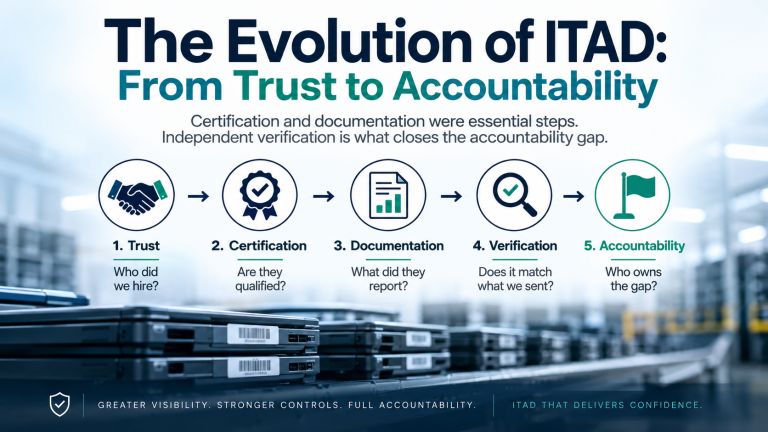
The Evolution of ITAD: From Trust to Accountability
Certification and documentation were essential steps. Independent verification is what closes the accountability gap.
For decades the ITAD industry has tried to answer one question: how can an organization be confident that its retired IT equipment was handled responsibly?
The industry has progressed from trust to certification to documentation. The next evolution is independent verification—and with it, a new era of accountability. Each advancement reduces the amount of blind faith customers must place in their providers. One question, however, remains largely unanswered:
How do you know every asset entrusted to the disposition process was actually accounted for?
After more than 20 years running an ITAD operation, I’ve reached a conclusion that may make some providers uncomfortable: customers should independently verify our work.
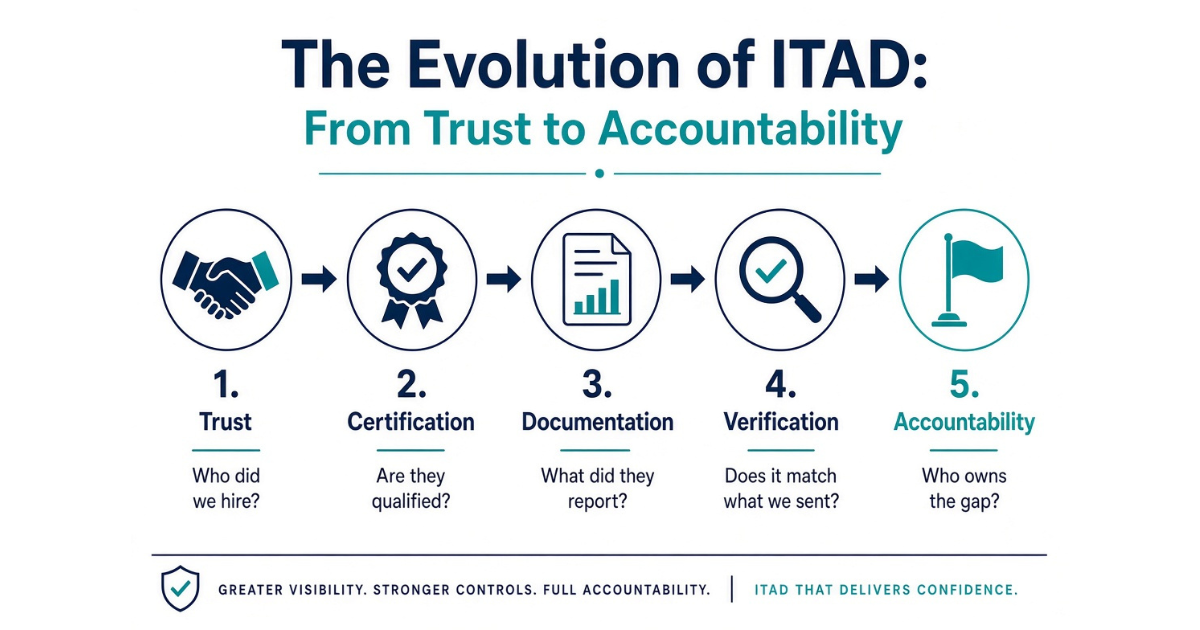
1. Trust: “We hired a reputable vendor.”
Early on, organizations chose a recycler or ITAD provider on reputation—years in business, solid references, no known incidents—and trusted them to handle equipment responsibly.
Confidence is not evidence. Once equipment left the building, customers had little visibility into whether everything collected reached its destination, whether every data-bearing device was sanitized, or whether materials were handled responsibly.
Trust works until it doesn’t.
2. Certification: “We hired a certified vendor.”
Standards such as R2 and e-Stewards introduced documented procedures, third-party audits, and greater attention to data security, environmental compliance, and downstream accountability. This was real progress.
Certification establishes that a provider has systems and controls for managing assets, including inventory and chain-of-custody procedures. It does not, by itself, independently establish that those controls accounted for every asset in a particular customer transaction. A certified vendor with well-designed procedures can still experience a missing asset, a shipping discrepancy, or a break in chain of custody.
Organizations sometimes treat certification as though it transfers responsibility for asset accountability to the vendor. It does not.
3. Documentation: “We have the certificates.”
Serialized inventories, certificates of data destruction, recycling certificates, and downstream records gave customers tangible evidence to retain for audits and compliance.
Documentation carries a structural problem: the vendor performing the work generally produces the records showing the work was done.
Consider an organization that retires 100 laptops. The provider receives 98, processes them correctly, and issues a certificate for 98. The certificate is accurate. The provider may have followed every applicable procedure for the equipment it received. But two laptops remain unaccounted for. Unless someone compares the 100 expected against the 98 reported, the discrepancy may never be discovered.
Documentation proves what was reported. It does not prove what was missing.
4. Verification: “We reconciled what we expected against what happened.”
Verification changes the question. Instead of asking whether the vendor followed procedures and produced the required records, it asks whether the evidence accounts for the assets that were supposed to be processed.
It starts with an independent expected inventory—the customer’s record of what it intended to dispose of—reconciled against evidence of collection, receipt, processing, and final disposition. Where records agree, assets are accounted for. Where they do not, discrepancies surface for investigation.
This is the shift: the completeness of a vendor’s reporting is tested against an independent expectation rather than accepted on its own terms.
In practice, verification relies on a few controls:
- Independent reconciliation, performed by a party independent of the processing activity.
- Two-Key Tracking, using independently established asset identifiers to reconcile expected equipment against actual disposition records, rather than relying exclusively on identifiers reported by the processor.
- Equipment Verification Holds, keeping assets from being processed or destroyed until required identification and reconciliation steps are complete.
- Exception management that investigates missing or mismatched assets rather than omitting them.
- Supporting evidence (photos, pickup records, custody records) that establishes what happened to specific assets.
- Verification does not guarantee nothing is ever lost, and reconciliation alone cannot establish an asset’s physical fate without supporting evidence. What it does is make discrepancies hard to overlook and easier to investigate.
5. Accountability: “We can explain what happened.”
Trust establishes a relationship. Certification establishes expectations. Documentation establishes a record. Verification tests the record.
Accountability assigns ownership of the outcome.
Verification can identify a missing asset. It cannot decide whether the discrepancy warrants a breach investigation, whether the risk is acceptable, or who must answer for the failure. Those are governance decisions.
Verification supplies the evidence. Accountability ensures someone acts on it.
In an accountable program a missing asset is not a reporting discrepancy. It is an exception with an owner, a deadline, and a documented resolution. That means:
- Every exception has a named owner on the customer side, not only the vendor’s.
- Investigations are documented: what was checked, what evidence was found, what was concluded.
- Escalation is defined in advance for discrepancies involving data-bearing assets, regulated data, or volume thresholds.
- Residual risk is formally accepted. When an asset cannot be located, someone with authority signs off on that conclusion and its implications.
- Closure is recorded. Each disposition event ends with a reconciled population, a list of resolved exceptions, and a list of accepted risks.
- Accountability does not mean pretending failures never occur. A defensible program is not one in which nothing goes wrong; it is one in which the organization can explain what happened, support that explanation with evidence, and show that unresolved issues reached the right people.
The gap no one owns
The industry verifies plenty. Data sanitization is verified. Environmental management systems are audited. Downstream processing is evaluated. Independent verification of chain of custody and asset completeness has not become a routine expectation.
If we verify that data was destroyed, why not verify that every data-bearing asset reached destruction? If a vendor proves 98 laptops were sanitized, someone should establish whether 98 was the right number.
Disposition involves handoffs: IT maintains the inventory, a logistics provider transports, a processor sanitizes and recycles, compliance retains the certificates. Each party can perform its role correctly while no one owns the question of whether the full population made it through.
A vendor can do everything right with the equipment it receives and still leave the customer exposed for equipment that never arrived.
That is the ITAD accountability gap.
Why now
Comprehensive reconciliation used to be labor-intensive: matching expected inventories against pickup records, processor reports, and serial numbers by hand. That cost helped keep vendor documentation the default.
Automation and AI change the economics. They can normalize inconsistent data, match records, flag discrepancies, and prioritize exceptions for human review. They cannot determine where a missing laptop went by comparing spreadsheets, but they make it much harder to miss that it is missing.
As automation and AI reduce the cost and complexity of reconciliation, the argument that comprehensive verification is impractical becomes increasingly difficult to sustain. Organizations may still choose not to verify. But that choice becomes harder to defend when effective controls are readily available.
Needing to trust less
These stages are cumulative. Verification does not replace certification; accountability does not replace documentation. The first four stages describe how organizations gain assurance. The fifth describes what they do with that assurance. Organizations still need qualified providers, sound processing controls, and evidence of sanitization and environmental compliance.
Certification established standards. Documentation created records. Verification makes those records testable. Accountability closes the loop by ensuring discrepancies are investigated, explained, and owned.
The question is no longer simply whether a vendor handled equipment properly. It is whether the organization can account for everything it entrusted to that vendor.
The future of ITAD isn’t about trusting vendors less. It’s about needing to trust them less.